Your Journey Starts Here!
You see the opportunity in commercial real estate. Higher commissions. Bigger deals. A chance to work with serious investors and business owners. But between where you are now and where you want to be lies a gap filled with unfamiliar terms, complex calculations, and skills you haven’t developed yet.
GACS is your launchpad.
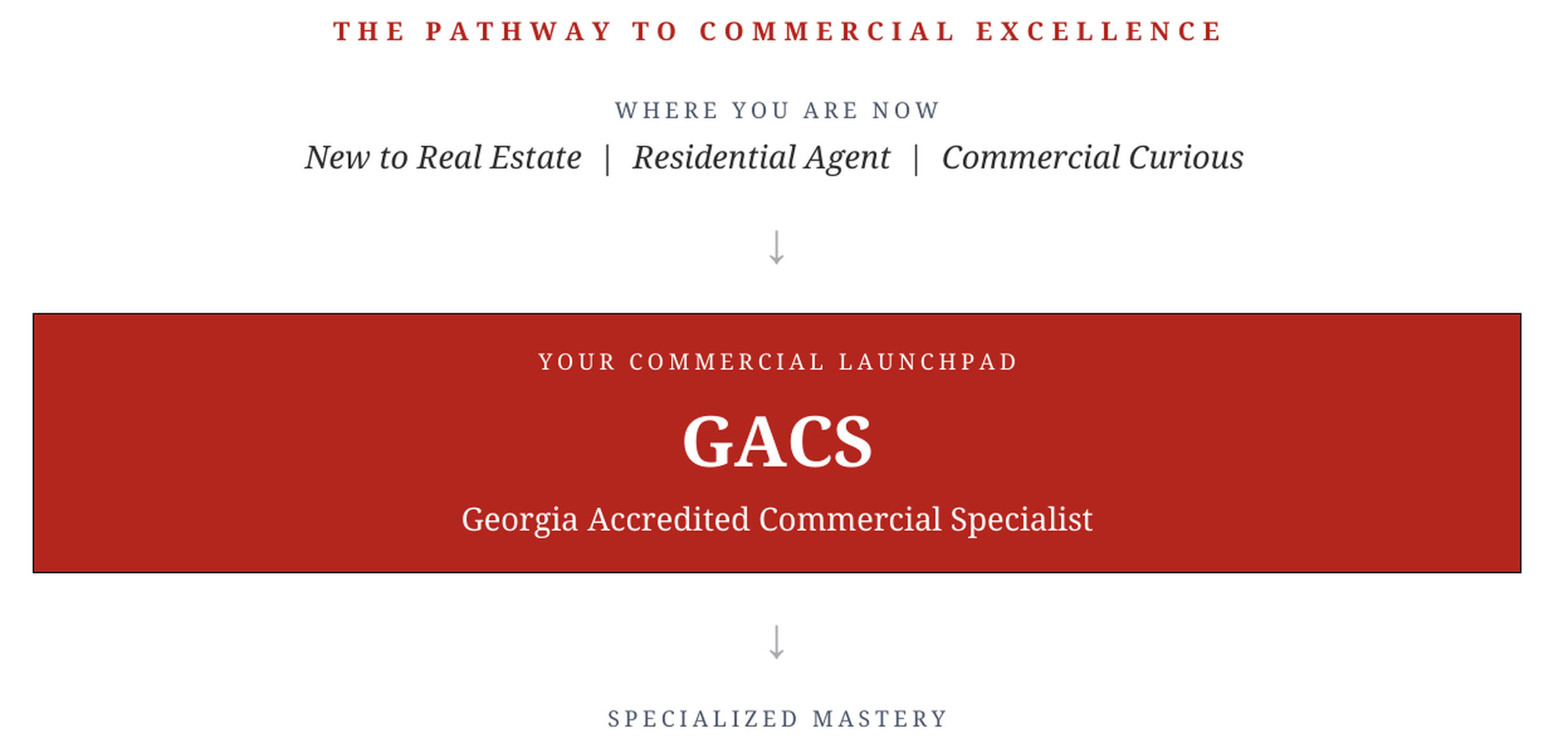
The Georgia Accredited Commercial Specialist designation isn’t just another certificate—it’s a deliberate launchpad designed to propel you from commercial curiosity to commercial competence. We bridge the knowledge gap between residential practice and commercial proficiency, giving you the foundational skills you need to confidently enter the commercial arena.
CCIM
Investment
SIOR
Office/Industrial
ALC
Land
CPM
Property Management
GACS positions you for success—not as an endpoint, but as the launchpad that makes advanced designations achievable. Think of it as building your commercial foundation: broad enough to give you confidence across multiple property types, deep enough to make you genuinely competent in transactions.
The Challenge
Commercial real estate operates under entirely different dynamics than residential. The agents who try to “wing it” without proper preparation often face costly mistakes, lost deals, and damaged reputations. Here’s what stands between most agents and commercial success:
The Financial Analysis Gap
In residential, you price homes based on comparables and emotional appeal. In commercial, you’re advising investors and business owners on one of their biggest financial commitments—and they expect you to speak their language fluently.
- Net Operating Income (NOI): Understanding how to calculate and analyze operational profit before debt and taxes—the foundation of commercial valuation
- Capitalization Rates: Knowing that a 4% CAP rate isn’t “bad” and 10% isn’t “good”—they reflect different risk-return profiles
- Cash-on-Cash Returns: Calculating actual returns on invested capital, accounting for leverage
- Internal Rate of Return (IRR): Projecting long-term investment performance including appreciation
- Going-in vs. Stabilized CAP Rates: Distinguishing current performance from projected future performance
The Legal & Regulatory Complexity
In residential real estate, laws typically favor consumer protection. Commercial operates under a vastly different legal landscape where courts expect all parties to be sophisticated. Ignorance of terms is rarely accepted as an excuse.
- Zoning and Land Use Regulations: Understanding use classifications, variances, conditional use permits, and how they affect property value
- Development Entitlements: Knowing what approvals are needed, how long they take, and what risks they carry
- Environmental Considerations: Due diligence requirements, Phase I assessments, and liability implications
- Higher Liability Standards: Courts expect commercial practitioners to understand contract intricacies
The Lease Structure Maze
Commercial leasing is dramatically different from residential. Terms like triple-net (NNN), gross leases, percentage rent, and tenant improvement allowances can be confusing for new agents—and getting them wrong costs your clients money.
- NNN, Modified Gross, Full Service: Knowing which expenses pass through to tenants and how that affects NOI
- CAM Charges: Common Area Maintenance calculations and reconciliations
- Tenant Improvement Allowances: Negotiating build-out contributions and understanding their impact on effective rent
- Lease Escalations: Structuring annual increases and understanding market vs. contractual rent growth
The Extended Timeline & Complexity
Unlike residential deals that often close in 30-60 days, commercial transactions can take months or even years. This extended timeline requires different skills and financial planning.
- Longer Due Diligence Periods: Physical inspections, environmental assessments, financial audits, and title work take time
- Multiple Decision Makers: Corporate clients involve committees, boards, and multiple stakeholders
- Complex Financing: Understanding commercial lending requirements, DSCR ratios, and lender underwriting
- Patience & Financial Reserves: Managing income gaps while building your commercial pipeline
The Sophisticated Client Expectation
Residential buyers often make emotional decisions. Commercial clients—investors, corporations, developers—make analytical decisions based on returns, risk, and strategic fit. They expect their broker to add value through expertise, not just access.
- Detailed Financial Analysis: Clients expect pro formas, sensitivity analyses, and investment comparisons
- Market Expertise: Deep knowledge of local market conditions, trends, and comparable transactions
- Strategic Advisory: Helping clients see opportunities they might miss and risks they need to avoid
- Professional Network: Access to lenders, attorneys, inspectors, and other specialists
The bottom line: Other commercial agents won’t teach you or co-broker with you if you don’t know what you’re doing. Most commercial brokers don’t appreciate residential agents trying to close deals they don’t understand. Commercial brokerage is not something you wing—you have to build a base of knowledge first.
The Transformation
GACS equips you with the skills, knowledge, and confidence to operate competently in commercial real estate. Here’s what you’ll gain:
FINANCIAL ANALYSIS FLUENCY: Master the metrics that drive commercial decisions
- Calculate and analyze Net Operating Income (NOI) accurately—understanding what to include, exclude, and normalize
- Apply capitalization rates intelligently—knowing when to use going-in vs. stabilized rates and what different rates signal about risk
- Build basic pro formas that project cash flows, returns, and investment performance over time
- Understand how leverage affects returns—cash-on-cash calculations that show actual investor yield
- Speak the language of investors fluently—IRR, equity multiples, debt coverage ratios
COMMERCIAL LEASING COMPETENCE: Navigate lease structures with confidence
- Understand and explain different lease types—NNN, gross, modified gross—and their implications for landlords and tenants
- Calculate effective rent including TI allowances, free rent periods, and escalations
- Represent landlords and tenants effectively—knowing the leverage points and negotiation strategies for each side
- Structure leases that protect your client’s interests while creating workable deals
- Read and interpret existing leases during due diligence—identifying risks and opportunities
LAND USE AND ZONING EXPERTISE: Understand the regulatory framework that shapes value
- Read and interpret zoning codes—understanding use classifications, density limits, setbacks, and FAR
- Identify highest and best use—recognizing when current use doesn’t maximize property potential
- Navigate the entitlement process—variances, conditional use permits, rezoning applications
- Assess development feasibility—understanding what can be built and what approvals are needed
- Recognize regulatory risks—nonconforming uses, pending code changes, and environmental restrictions
TAX STRATEGY AWARENESS: Understand how taxes shape investment decisions
- Explain depreciation benefits—how real estate generates tax shelter even while generating positive cash flow
- Understand 1031 exchange fundamentals—timing requirements, identification rules, and strategic applications
- Recognize cost segregation opportunities—accelerating depreciation to maximize early tax benefits
- Discuss capital gains implications—short-term vs. long-term, depreciation recapture
- Know when to involve specialists—recognizing the boundaries of your advisory role
The Result: You become the agent who can competently handle commercial opportunities—not someone who has to refer them away or fumble through unfamiliar territory. You earn credibility with sophisticated clients and respect from commercial colleagues.
Program Overview
Course Credit Required: 36 Hours
Divided into six comprehensive modules, each providing 6 CE hours of commercial education.
Comprehensive Curriculum: 6 Modules
Module 1 – The Wide World of CRE: This course is a comprehensive intensive designed for real estate professionals looking to transition from residential brokerage or deepen their foundational knowledge of the commercial sector. This course demystifies the complexities of commercial transactions, moving beyond simple “property sales” into the realms of data-driven market intelligence, sophisticated advisory roles, and the nuances of various asset classes. Students will gain a holistic understanding of Commercial Real Estate as an information-heavy service business, learning to navigate the critical differences in valuation, financing, and client expectations that define the industry.
Module 2 – Commercial Leasing: This intensive course provides a comprehensive deep dive into the mechanics of commercial leasing, designed for professionals who want to master the complexities of the landlord-tenant relationship and the financial structures that drive property value. Students will explore the strategic importance of leasing income in property appraisal and the nuances of various tenancy types.
Module 3 – Evaluating & Pricing: This course transitions students from basic investment concepts to the high-stakes world of commercial property analysis. You will begin by establishing a strong foundation in investment fundamentals, comparing real estate against traditional asset classes like stocks and bonds. From there, the curriculum dives deep into the professional world of valuation, demystifying the three primary appraisal approaches: Sales Comparison, Cost, and Income Capitalization.
Transaction Component
Candidates must participate in and complete commercial transactions before being awarded certification.
SCHOLARSHIP OPPORTUNITY: GACS certification classes qualify for the GAR licensee scholarship program. After course completion, you may be eligible for partial or full tuition reimbursement, subject to available funds and scholarship guidelines.
Meet Your Guide
 |
| MARTY J. RUETER |
| GACS Program Lead Instructor |
|
Fourth-generation REALTOR®, executive, author, trainer, coach, and accomplished keynote speaker whose fast-paced but fact-filled programs have wowed audiences throughout North America for decades. Every successful journey needs a guide who’s been where you want to go. For GACS, that guide is Marty Rueter—a fourth-generation REALTOR® whose career spans the full spectrum of real estate practice. |
Why Marty?
Marty’s background covers booms and busts, multiple markets and disciplines—residential, commercial, industrial brokerage, sales, exchanging, leasing, business sales, syndications, and property management. Currently, he leads a 100-plus team of “commercial-only” brokers in Greater Atlanta, providing both analytical expertise and street-level perspective.
Credentials
- 4th generation REALTOR®—family business began in 1900
- Co-founder & President, Weichert Real Estate Affiliates (316 offices, 39 states)
- Executive Vice President, Coldwell Banker Commercial Metro Brokers
- Senior Executive, Century 21 International
- Ranked #56, Swanepoel Power 200—Most Influential Real Estate Executives (2015)
TEACHING PHILOSOPHY: “A self-described ‘real estate zealot,’ Marty’s high-energy, humorous but meaty presentations breed enthusiasm that’s contagious and an in-depth expertise that’s practical, understandable, and motivating.”
Leadership & Contact
2026 GACS DEAN: Van A. Yon, Atlanta Commercial Board of REALTORS®
2026 GACS ASSOCIATE DEAN: Bob Espy, Perimeter East Association of REALTORS®
LEAD INSTRUCTOR: Marty J. Rueter, Executive Vice President, Coldwell Banker Commercial Metro Brokers
GACS Application
Click on the links below to fill out and download both applications. If you have questions, contact the Professional Development Department at or 470-990-7368.